

CONTRIBUTORS

Sonal Desai, Ph.D.
Chief Investment Officer, Franklin Templeton Fixed Income
The US Federal Reserve finally acknowledged inflation is not a “transitory” problem and signaled a greater degree of concern; but investors seem to think that the Fed will blink when markets balk. With consumer inflation at multi-decade highs and COVID-19 risks still alive, what’s next for the monetary policy response—and market implications—as we move into 2022? Our Fixed Income CIO Sonal Desai shares her views.
The Federal Reserve (Fed) finally acknowledged that high inflation is not transitory—but markets believe its resolve to fight it is.
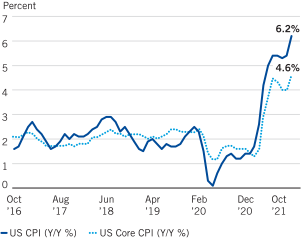
It was high time for the Fed to recognize we have an inflation problem on our hands. Already with the June release, when US Consumer Price Index (CPI) inflation rose above 5%, I had noted that significant price increases were not limited to a few outliers but had spread to several goods and services categories.
Since then, it’s become even clearer that inflation pressures are broad-based and not just due to base effects: core CPI reached 4.6% year-over-year (Y/Y) in October and has been at or above 4% for five consecutive months. Alternate measures of inflation like the San Francisco Fed’s Cyclical Core PCE and the New York Fed’s Underlying Inflation Gauge have also risen sharply.1 Headline inflation jumped to a 31-year high of 6.2% Y/Y.
Over a year ago, we at Franklin Templeton Fixed Income were already an outlier with our significantly above-consensus inflation call. Four months ago, I again flagged the risk that markets and policymakers might still be underestimating inflation, and I pointed to two factors: the likelihood that high inflation would show a significant degree of inertia, and the dichotomy between consumers and businesses, who expected inflation to persist, and most financial investors who appeared convinced it would not.
Inflation inertia is now baked in the cake. Suppose that the inflation reading for November drops back to 0.2% month-over-month (M/M)—the 2017-2019 average—and stays there. Y/Y inflation will still remain above 6% until next February, and average 5.5% in the 12-month period through May 2022. And that now seems like a best-case scenario, because M/M inflation has averaged 0.6% since the beginning of the year.
Suppose that M/M inflation remains at 0.6% for a while longer, let’s say another six months—remember, it’s already averaged 0.6% for the past 10 months. In that case, Y/Y inflation would rise above 7% in December, peak at close to 8% in February-March, and only drop below 5% a year from now. What’s more, inflation would average 5.4% over a full two years, 2021-2022.
The longer inflation stays in the 5%-6% range, the more it changes the behavior and expectations of consumers and producers. The anecdotal evidence is piling up: companies are getting used to being charged higher input prices and to charging higher prices for their products—that’s a regime shift from the last many years. Workers are negotiating higher wages with labor demand still outstripping supply. By the middle of next year, these behavior changes will have become even more ingrained.
Fed Chairman Jerome Powell has finally acknowledged it’s time to retire the “transitory” moniker. First in a recent speech and then testifying to Congress, he conceded that “transitory” can mean different things to different people. Indeed. Does it mean a few months? A few quarters? A few years? He said that for the Fed it means that “it will not lead to permanently or very persistently higher inflation.” Well, nothing in life is permanent, and “very persistent” is also rather ambiguous. Would one year of inflation above 5% qualify? Because that’s already looking like a best-case outcome, as I noted above.
In a recent seminar, Powell also admitted that the Fed’s “patient” approach might not be a perfect match for an environment of sustained supply bottlenecks and energy price increases, and for the first time he sounded more concerned about inflation than about unemployment.2
Markets took notice and got nervous, and the five-year breakeven rate rose well above 3%.
Then news of the COVID-19 Omicron variant broke, and markets quickly scaled back down their expectations of Fed tightening. To some, this feels like 2018, when Powell signaled a tougher monetary stance, the markets balked and the Fed blinked.
There’s a big difference, though. In 2018, inflation was running in a 2%-3% range; today it’s above 6% and likely to stay in a 5%-6% range for a while, as I argued above.
Inflation Running Much Higher Than Past Periods
US Consumer Price Index (CPI) October 2016–October 2021
Source: Bureau of Labor Statistics (BLS). As of October 2021.
Several countries have re-imposed some COVID-related restrictions as a precaution, but we have no evidence at this point that the Omicron variant will plunge the global economy back in full-scale lockdown.
Markets seem to be betting that the Fed will want to take its own precautions and keep monetary support going as insurance against the downside risks to growth. After all, that’s what the Fed has promised and done over much of the past decade: with inflation risks always low, it focused on growth risks. This time, however, inflation is not just a risk, it’s a reality—a clear and present problem. And if the Fed holds off on tightening, it’s going to get worse.If the Fed does not tighten with inflation running at 5%-6%, inflation expectations will likely get even more unanchored.
Equally important, inflation has now become a serious political liability for the Biden administration. The longer consumers face rising prices, the more dissatisfied they become with the state of the economy. This translates into lower approval ratings for the administration and rising political pressure to bring inflation under control—and this pressure spills over onto the Fed.
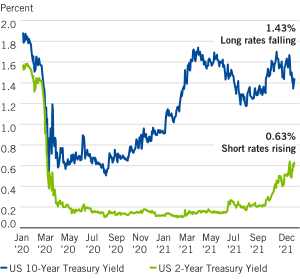
Because of these important differences with 2018, I do not believe that the recent strong rally in bond markets can prove sustainable. Unless a new global recession really hits, because of Omicron or another unexpected shock, the bond market is likely underestimating the inflation problem, and underestimating the constraints the Fed now faces.
Recent Rally in Bond Markets Not Sustainable
US Treasury Yields (%) January 1, 2020–December 6, 2021
Source: Bloomberg. As of December 6, 2021. See www.franklintempletondatasources.com for additional data provider information
ENDNOTES
-
Sources: Bureau of Labor Statistics (BLS), Federal Reserve Bank of San Francisco, Federal Reserve Bank of New York.
-
Source: BIS-SARB Centenary Conference, October 22, 2021.
What Are the Risks?
All investments involve risks, including possible loss of principal. The value of investments can go down as well as up, and investors may not get back the full amount invested. Bond prices generally move in the opposite direction of interest rates. Investments in lower-rated bonds include higher risk of default and loss of principal. Thus, as prices of bonds in an investment portfolio adjust to a rise in interest rates, the value of the portfolio may decline. Changes in the credit rating of a bond, or in the credit rating or financial strength of a bond’s issuer, insurer or guarantor, may affect the bond’s value.