
CIO VIEWS
CONTRIBUTORS

Sonal Desai, Ph.D.
Chief Investment Officer,
Franklin Templeton Fixed Income
US Treasuries have rallied sharply over recent weeks with yields dropping by about 30 basis points,1 and analysts are scrambling with differing explanations. However, the growth outlook has not actually changed. I see three possible scenarios, which I discuss below. But regardless of which scenario plays out, something in the current constellation of asset prices does not add up. Over the next six months, most likely, we will find out what does.
The unusual degree of uncertainty in the current macro environment allows for a wide variety of views on how things will play out. I don’t have a crystal ball, but I would not bet on the dream constellation of strong policy-supported economic growth, low and stable inflation, loose monetary policy and ever-rising asset prices that markets seem to hope for. Something has to give. I see three main possibilities.
A first possible scenario sends us back to secular stagnation. Growth fizzles out by the end of the year. Maybe political disagreements will close the door to additional US fiscal stimulus. Or a resurgence of COVID-19 cases could trigger another round of restrictions (I could see this happening in Europe after the summer tourist season). After a strong brief rebound in growth and a sharp short-lived jump in inflation, we quickly get back to a long run of slow growth, low inflation and low interest rates. This by the way is the view implicit in the official growth forecasts of the US administration (as embodied in the budget assumptions, and consistent with those of the Congressional Budget Office).
What doesn’t add up here? Asset prices. If economic growth fizzles out, the stock market needs to reprice for modest earnings expectations. And if slow growth is as good as it gets, the Federal Reserve (Fed) will need to accept that loose monetary policy cannot boost activity and will have to unwind its massive monetary easing—which again should translate in lower asset prices. Or, the Fed could decide to maintain a very easy monetary stance anyway—but that sooner or later will result in increasing distortions in markets, leading to financial instability, or inflation, or both—again bad news for markets.
A second scenario envisions a productivity renaissance. The policy-fueled demand surge generates a proportionate supply response: workers come back into the labor force and companies quickly ratchet up production, easing bottlenecks. Meanwhile, both governments and companies redouble their research and development efforts, accelerating innovation and infrastructure and generating a rapid pickup in the pace of productivity growth. The supply response and productivity acceleration enable fast economic growth and healthier wage gains.
Asset prices remain elevated
S&P 500 market capitalization-to-US-gross domestic product (GDP) ratio (April 1, 2020–July 8, 2021)
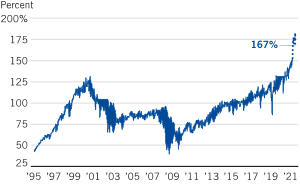
Sources: Franklin Templeton Fixed Income Research, SPDJI, Macrobond.
What doesn’t add up here? Interest rates. The current ultra-loose monetary stance will appear unnecessary even sooner. The Fed will be under heavier pressure to bring forward its policy tightening, especially if inflation remains elevated. In principle, faster productivity growth should help cap inflation. In practice, it’s likely to take longer for greater investment to translate into faster productivity growth. Meanwhile, we’ll have an economy at full employment and firing on all cylinders; and stronger productivity growth implies a higher natural rate of interest, the infamous “r-star.” Markets will have to start pricing in higher rates. Stock markets will be supported by the tailwind of productivity on earnings, corporate bonds will benefit from a healthier profitability outlook, but long-duration “safe-haven” assets will look markedly less attractive.
The third scenario sees a classic overheating. Demand continues to recover at a fast pace as post-pandemic life gets back to (almost) normal: supply struggles to catch up; industries need more time to work through supply chain disruptions; labor force participation remains below pre-COVID levels; past underinvestment in raw materials extraction keeps their costs elevated. In short, an extension of what the data are telling us now.
What doesn’t add up here? Inflation. In this classic overheating scenario, loose monetary and fiscal policies feed sustained inflation. Not (necessarily) a return to the 1970s, but a persistent 3%–5% that gets entrenched into wage and price setting seems quite realistic. This will put the Fed in a bind: the longer it waits to reverse course, the harsher the tightening when it finally comes. Market rates will move up faster than the Fed, punishing duration exposure in fixed income. Stock markets should be initially well supported, but then increasingly nervous as the Fed gets ready to tighten.
Supplier delivery times appear to have peaked, but remain elevated relative to historical levels
ISM manufacturing report on business supplier delivery times (January 2000–June 2021)
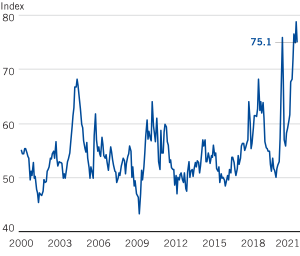
Sources: Franklin Templeton Fixed Income Research, Institute for Supply Management, Macrobond.
I don’t have a crystal ball. I have my most likely scenario, but you can pick your own. At the moment, the economic data are mostly consistent with the overheating scenario, whereas market reactions suggest something in between the secular stagnation (with the recent decline in 10-year US Treasury yields) and the dream scenario (with stock indices still at record high). Something has to give. Place your bets, and get ready for more volatility as we find out what does.
ENDNOTES
-
One basis point is equal to 0.01%.
WHAT ARE THE RISKS?
All investments involve risks, including possible loss of principal. The value of investments can go down as well as up, and investors may not get back the full amount invested. Bond prices generally move in the opposite direction of interest rates. Investments in lower-rated bonds include higher risk of default and loss of principal. Thus, as prices of bonds in an investment portfolio adjust to a rise in interest rates, the value of the portfolio may decline. Changes in the credit rating of a bond, or in the credit rating or financial strength of a bond’s issuer, insurer or guarantor, may affect the bond’s value. Actively managed strategies could experience losses if the investment manager’s judgment about markets, interest rates or the attractiveness, relative values, liquidity or potential appreciation of particular investments made for a portfolio, proves to be incorrect. There can be no guarantee that an investment manager’s investment techniques or decisions will produce the desired results.