
CONTRIBUTORS

Sonal Desai, Ph.D.
Chief Investment Officer, Franklin Templeton Fixed Income
At its September policy meeting, the US Federal Reserve (Fed) cut its benchmark interest rate by 25 basis points (bps), to a range of 1.75% to 2%,1 validating market expectations.
Chairman Jerome Powell’s message in the press conference following the meeting, however, was more carefully calibrated than in the past—in my view—and it had a sobering effect. While the market’s immediate reaction was disappointment, I believe the Fed needed to rein in market expectations on the future path of rates. This was a reasonable first step.
With two rate cuts under his belt this quarter, Powell said he expects this latest monetary easing to have an impact with the usual long and variable lags; and, he noted that the Fed expects growth to remain solid, the labour market to stay strong and inflation to gradually move up to its target.
The Fed stated it will keep monitoring trade uncertainty and the recent weakening in Europe and China. However, the US outlook remains unchanged, with strong household consumption and a cautious business sector. And while the Fed can’t eliminate trade uncertainty, Powell expressed confidence that the Fed’s moves will support durable goods consumption, the housing sector, and consumer and business confidence.
In other words, the message from the Fed is that there is no reason to panic, we are not on the verge of a recession, and there is no reason to expect massive further monetary easing.
Indeed, Powell sounded unimpressed by yield curve inversions: He noted that US long-term Treasury yields had dropped sharply and then retraced most of the movement within a few days. He stated swings in global demand for US Treasuries and in market sentiment play a key role in the inversion, and the Treasury yield curve does not tell us much about the US economic outlook. Perhaps unsurprisingly, I find myself in agreement with Powell here.
The Fed stands ready to act again if needed, but right now it sees this as a mid-cycle adjustment whose growth-supporting impact should be felt in the coming months and into next year. That seems supported by a split in the Federal Open Market Committee (FOMC): two voting members again dissented, wanting to keep rates on hold, while a third dissenter wanted a 50 bps cut.
Earlier in the year, the Fed had backed itself into a corner, becoming captive to market expectations of rate cuts. Today it has gone some ways towards extricating itself, making a stronger case for waiting to see the impact of these rate cuts—and reiterating that the US economy remains solid.
The quick retracing of the 10-year US Treasury in recent days is another sign that markets had gotten well ahead of themselves in expecting a prolonged easing cycle. We remain cautious on lengthening US duration2 at these levels, at a time that fundamentals show resilience.
Here are the latest economic projections from the Fed:3
- The Fed slightly increased its 2019 US gross domestic product growth forecast to 2.2%, from 2.1% previously, but kept is 2020 forecast steady at 2.0%.
- The inflation projection (based on Core Personal Consumption Expenditures) was kept steady at 1.8% for 2019 and 1.9% for 2020.
- The 2019 projection for the unemployment rate edged up slightly to 3.7% from its prior projection of 3.6%. The 2020 projection held steady at 3.7%.
US Interest Rate Expectations Implied Fed Funds Target Rate
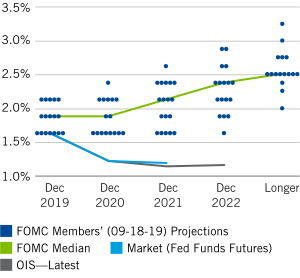
Sources: Bloomberg, US Federal Reserve, Franklin Templeton Capital Market Insights Group. OIS (overnight index swap)/market consensus. Participants’ projections of the appropriate level of the target federal funds rate (rounded to the nearest 1/8 percentage point) at the end of the specified calendar year. Participants’ projections are summarized in the form of a median, weighted average, central tendency and range. The central tendency is the range of participant projections, excluding the three highest and three lowest projections for each year. The straight lines between each calendar year-end projection are based on a simple linear interpolation. There is no assurance that any projection, estimate or forecast will be realized. For illustrative purposes only.
ENDNOTES
-
A basis point is a unit of measurement. One basis point is equal to 0.01%.
-
Duration is a measure of the sensitivity of the price of a fixed income investment to a change in interest rates. Duration is expressed as a number of years.
-
Source: US Federal Reserve. There is no assurance that any estimate, forecast or projection will be realized.
WHAT ARE THE RISKS?
All investments involve risks, including possible loss of principal. The value of investments can go down as well as up, and investors may not get back the full amount invested. Bond prices generally move in the opposite direction of interest rates. Thus, as prices of bonds in an investment portfolio adjust to a rise in interest rates, the value of the portfolio may decline.